Quick Answer
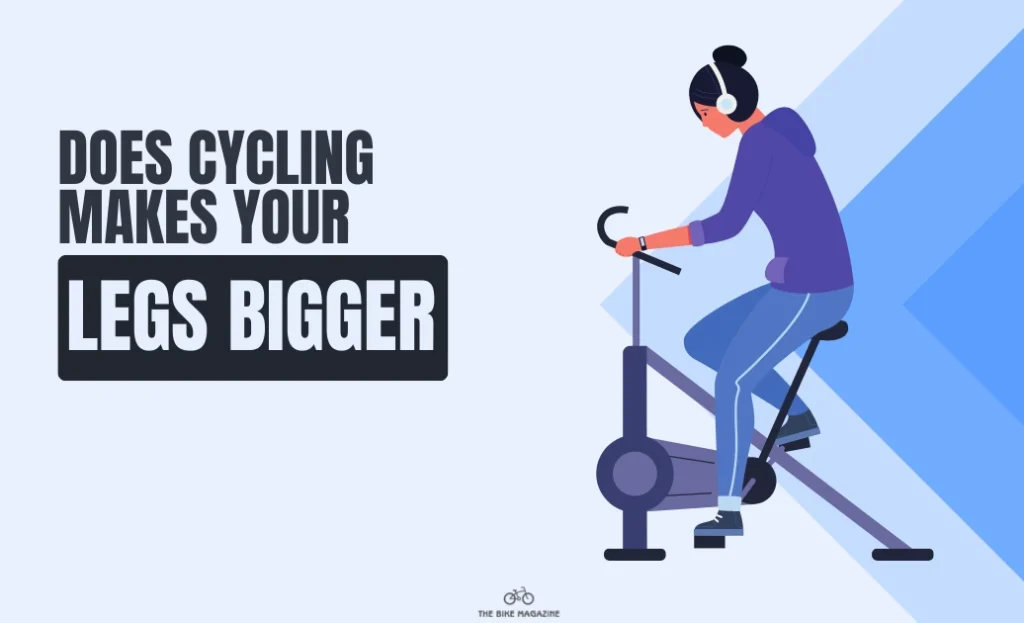
No – for most riders, cycling does not make the legs bigger. It is an aerobic exercise that strengthens and tones the quads, hamstrings, glutes and calves. To build bigger legs you would need low-cadence, high-resistance riding plus strength training.
No, cycling does not make your legs bigger, instead, it strengthens your legs muscles without necessarily overstressing them. As you cycle your quads, hamstrings, glutes, and calves are put to task. Remember that cycling is an aerobic exercise and every time that you work out your endurance muscle fibers are put to task making your legs resistant to fatigue.
If you are however looking to make your legs bigger there are a couple of exercises that you can combine but which will require a lot of time and effort. Below we outline some of the exercises that you can adopt to make your legs bigger but which will be discussed later in this article. For now, let us find what cycling does to the legs.
Your Body
What Cycling Does to Your Body
Cycling Strengthens Your Legs
To achieve leg strength through cycling you should use low cadence and which is below 80 revolutions per minute and high resistance. Be sure to use gear that provides some decent resistance, you could also gear back up until you increase your fitness levels.
Fitness enthusiasts can even make their lets stronger by incorporating the weight lifting exercises, such as leg presses and squats.
Cycling Builds Muscle Mass
Cycling helps build muscle mass more so in the areas around the hamstrings, glutes, calves, and quads.
Important to note is that muscle development doesn’t happen overnight but takes a bit of dedicated time to the exercises.
Cycling Leads to Enhanced Leg Endurance
For enhanced leg endurance it calls for an opposite effect and strength, fitness enthusiasts must, therefore, engage high cadence with low resistance as they work out.
Important to note is that a higher cadence will wear you out, so to counter that you might want to alternate between the lower resistance and higher cadence and vice versa until you can find a combination that resonates with your fitness level.
Cycling Tones Your Glutes and Butt Muscles
The hills offer the perfect resistance if you wish to perfectly tone your but muscles. When engaging the steep ascents, your muscles are forced to work harder than they normally would.
Each pedal stroke exerts stress on your glutes and the thigh muscles. The strenuous workout at times stimulates muscle fiber damage, which is a positive reaction for humans because it exerts high amounts of stress on the thigh muscles and the glute’s consequently giving them a hard time and a much harder workout.
Cycling Enables Low-impact Leg Toning
When you cycle you exert less stress on your joints which is why you can work out for an extended time without attaining injuries when compared to other exercises. Cycling is therefore a low-impact fitness routine that enables you to tone your muscles, quads, hamstrings, and glutes.
Fitness Riding Essentials
Indoor Cycling
Gaining Muscles by Cycling the Stationary Bikes
If you are not capable of finding challenging terrains to work your leg muscles as you cycle then the only other option is to invest in a stationary bike and then increase its resistance levels as you work out.
Higher resistance levels are necessary for individuals whose fitness objective is to gain muscle mass.
The bikes can be used to tone the legs, buttocks, and thighs, and by extension, the stationary bikes also work your back muscles, abdominal and arms.
When using the stationary bikes the large muscles in the front part of the thighs are worked especially when you do the downstroke, while the back muscles also known as the hamstrings are put to task when your legs pull when engaging the upstroke.
The calves on the other hand are engaged during both the down and the upstroke.
Leg Exercises
Exercises That Make Your Legs Bigger
Most of the fitness exercises that we will highlight must be done using the heavyweight’s equipment’s and given the task that is coming ahead, it is vital that you take your time to prepare your body and muscles through warm-ups.
Warms-upsminimize the chances of developing an injury because of a workout, and in rare cases, it lessens the post leg day DOMS.
A proper workout would involve some dynamic stretches meant to awaken your leg muscles.
The first workout is the deadlift, and which requires you to lift the barbell in front of you, do not lift it past your belly.
The second exercise are the leg presses, and which enable you to work your quad and hamstrings hard. You will sit on the machine, position yourself correctly, you will then bend your knees, by bringing them towards your chest and then press them back to the start.
You can also do the seated hamstring curl, the seated leg extension exercise, the dumbbell lunge, and lastly the dumbbell squat.
The back, front, and hack squats also help to make your legs bigger.
Keep Reading
More Fitness Guides


Workouts
Cycling Workout Routines That Focus on the Legs Only
Use a Recumbent Bike to Work Out
The advantage of using the recumbent bikes is that they offer more back support when compared to upright bikes. Fitness enthusiasts might, however, need some time to get used to using the recumbent bike.
The exercises that you can perform on the recumbent bikes are designed to work on your lower body.
Recumbent bikes work different muscles of the body including the quadriceps, glutes, and abs, but they can also be good equipment for toning your leg muscles from home.
Cycle for Extended Hours
If you want the perfectly toned legs then you will have to work out for at least 15-20 hours every week.
Important to note is that everyone’s body will react differently to the effects of cycling for extended hours. But you can always ride at a slow, and steady pace if you wish to burn fat to allow your muscle mass to grow. So as the fat decreases you will end up with an enhanced body and toned legs.
Cycle on Steep Ascents and Sprints
Cycling around steep hills and sprints helps make people stronger and in the process, it ensures that you build muscle. What’s more, sprinters who prefer to cycle on hills will be able to develop the best quads over time. Climbing the steep ascents thoroughly tones the arms and the legs providing quick results in a short time.
Gear For Leg-Focused Training
Train indoors or out and recover better with these simple pieces of gear.
Trainer accessory
KOM Cycling Front Wheel Riser Block
Levels the front wheel when your bike is on a trainer, with three heights for a natural riding position.
View on AmazonFoam roller
TriggerPoint GRID Foam Roller
A multi-density foam roller for loosening tight quads, hamstrings and glutes after a ride.
View on AmazonClipless pedals
Shimano PD-M520 SPD Pedals
Durable two-sided SPD clipless pedals – a classic choice for mountain biking, commuting and indoor training.
View on AmazonBike computer
SY Wireless Bike Computer
A simple waterproof speedometer and odometer that shows your speed, distance and ride time – handy for pacing and tracking progress.
View on AmazonSeat cushion
Zacro Gel Bike Seat Cushion
A soft gel saddle cover that adds padding for commuting, casual rides and indoor bikes.
View on AmazonCycling gloves
MOREOK Gel Padded Cycling Gloves
Half-finger gloves with 5 mm gel padding that reduce hand numbness and protect your palms in a fall.
View on AmazonAs an Amazon Associate, The Bike Magazine earns from qualifying purchases. Prices and availability are shown on Amazon.
Frequently Asked Questions
Quick answers to the questions riders ask most about cycling and leg size.
Is cycling good for the legs?
Yes, cycling is good for the legs because it improves the overall functioning of the lower body and proceeds to strengthen the leg muscles without necessarily putting pressure on them.
What will happen if I cycle every day?
If you cycle every day, you stimulate and improve the functioning of your heart, lungs and enhance blood circulation and which consequently minimizes the risk of cardiovascular diseases. Overall, cycling helps strengthen the muscles of the heart, it lowers the resting pulse and conveniently reduces the blood fat levels.
Does cycling impact one’s health negatively?
Cycling is associated with infertility, genital numbness, erectile dysfunction, and lower urinary tract symptoms among others.