
Quick Answer
V-brakes stop harder and are easier to set up; cantilever brakes clear more mud. Both are cable-pulled rim brakes. V-brakes use longer arms for more stopping power, while cantilevers leave more room around the tire, which is why they are still found on cyclocross and touring bikes.
Cantilever and V brakes are two of the most common types of bicycle brakes used in modern-day cycling. Both brakes have their unique features and advantages that make them suitable for different types of bikes and riding styles.
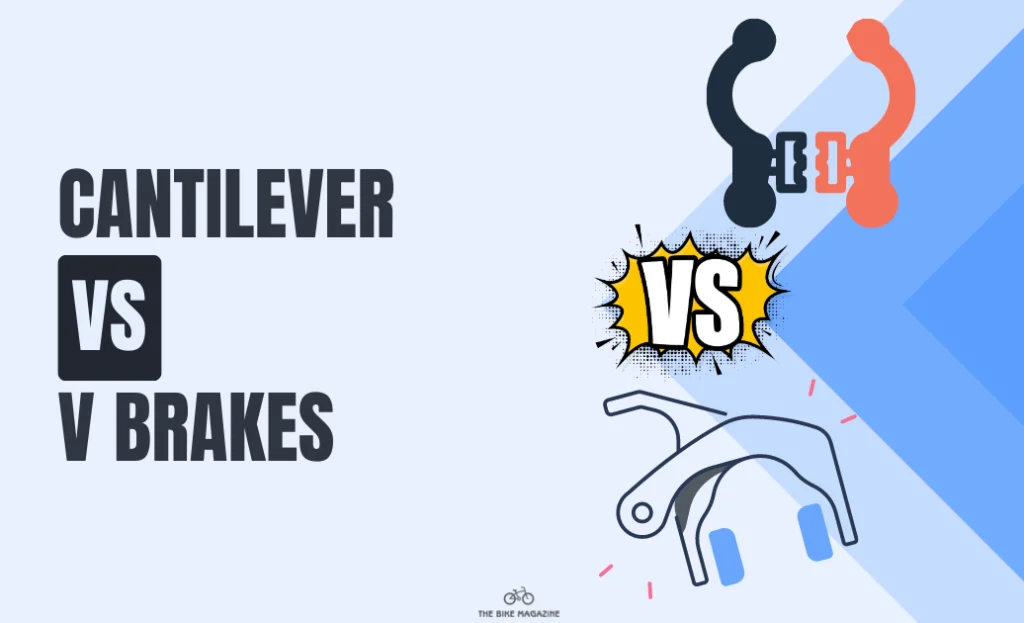
Cantilever brakes are a type of rim brake that uses a cable to pull two brake arms towards the rim of the wheel, creating friction and slowing down the bike. On the other hand, V brakes are a type of linear pull brake that uses a cable to pull two brake arms towards the rim of the wheel, creating a V-shape and providing more stopping power than cantilever brakes.
The choice between cantilever and V brakes ultimately depends on the type of bike and riding style. It is important to consider the advantages and disadvantages of each brake before making a decision.
The Basics
Cantilever Brakes vs V Brakes
What are Cantilever Brakes?
Cantilever brakes are a type of rim brakes that are commonly used on cyclocross and touring bikes. They consist of two brake arms that are mounted on opposite sides of the fork or seat stays.
The brake arms are connected to the brake levers by a cable, and when the levers are squeezed, the brake arms move inward, pressing the cantilever brake pads against the rim of the wheel.
What are V brakes?
V brakes, also known as linear-pull brakes, are a type of rim brake that are commonly used on mountain bikes and hybrid bikes. They consist of two brake arms that are mounted on the fork or seat stays, just like cantilever brakes.
However, the brake arms are longer and are angled in a V-shape, hence the name V brakes. When the brake levers are squeezed, the brake arms move inward, pressing the v brake pads against the rim of the wheel.
They are commonly found on mountain bikes due to their ability to provide more clearance for mud and debris.
Differences between Cantilever and V brakes
There are several differences between v brakes vs cantilever brakes that are worth considering when choosing one of these brakes:
- Power and Modulation: V brakes generally provide more stopping power than cantilever brakes, due to their longer brake arms and the fact that they apply force directly to the rim. However, cantilever brakes offer better modulation, meaning that it’s easier to apply a small amount of braking force without locking up the wheel.
- Clearance and Compatibility: Cantilever brakes require more clearance between the brake arms and the rim, which can be a problem on bikes with wider tires. V brakes require less clearance and are generally more compatible with a wider range of bikes.
- Maintenance and Adjustment: Cantilever brakes are generally easier to maintain and adjust, as they have fewer moving parts and are less complex than V brakes. However, V brakes are easier to set up initially, as they require less precise positioning of the brake arms.
Brake Upgrade Picks
How They Work
Braking Mechanism
How do Cantilever Brakes Work?
Cantilever brakes work by using a pair of brake arms that are attached to the frame of the bike, near the seat stays or fork legs.
When the rider pulls the brake lever, a cable is pulled, which causes the brake arms to pivot towards the rim of the wheel. The brake pads, which are attached to the brake arms, then make contact with the rim, creating friction and slowing down the bike.
How do V brakes Work?
V brakes, also known as linear-pull brakes, work in a similar way to cantilever brakes. However, instead of using brake arms that are attached to the frame, V brakes use a single brake arm that is attached to the frame via a V-shaped brake noodle.
When the rider pulls the brake lever, the cable is pulled, causing the brake arm to pivot towards the rim of the wheel. The brake pads then make contact with the rim, creating friction and slowing down the bike.
Advantages and Disadvantages of Cantilever Brakes
One advantage of cantilever brakes is that they tend to be more durable and less prone to damage from debris on the trail.
However, cantilever brakes can be less powerful than V brakes, which can be a disadvantage in certain situations, such as steep descents. Cantilever brakes are also generally harder to install and adjust than V brakes.
Advantages and Disadvantages of V brakes
One advantage of V brakes is that they are generally more powerful than cantilever brakes, which can be helpful in steep or technical terrain. They also tend to be lighter and more aerodynamic than cantilever brakes.
V brakes are easier to install and adjust than cantilever brakes, but they can be more prone to damage from debris on the trail but they have better stopping power.
Compatibility
Design and Compatibility
Design and Compatibility of Cantilever Brakes
Cantilever brakes are designed to provide a powerful and reliable stopping force. They are commonly used in cyclocross and touring bikes due to their ability to handle mud and other debris.
Cantilever brakes are compatible with most types of brake levers, making them a versatile choice for many riders. They are bit harder to install and maintain than V brakes.
Design and Compatibility of V brakes
V brakes are designed to provide a strong and responsive braking force. They are commonly used in mountain bikes due to their ability to handle steep descents.
V brakes are compatible with most types of brake levers, making them a popular choice for many riders. They are also relatively easy to install and maintain.
Installation and Maintenance of Cantilever Brakes
To install cantilever brakes will requires a bit more effort and skill than installing V brakes. The brake pads must be carefully aligned with the rim to ensure proper braking performance.
Additionally, the straddle cable must be adjusted correctly to ensure that the brake arms are parallel to the rim.
Maintenance involves regular cleaning and lubrication of the pivot points to ensure smooth operation.
Installation and Maintenance of V brakes
Installing and maintaining V brakes is relatively simple. The brake pads must be aligned with the rim, and the brake cables must be adjusted correctly to ensure proper braking performance.
Maintenance involves regular cleaning and lubrication of the pivot points to ensure smooth operation.
Stopping Power
Performance and Stopping Power
Performance of Cantilever Brakes
Cantilever brakes are known for their excellent mud clearance and ability to handle rough terrain.
They are also popular among touring cyclists due to their durability and strength. However, when it comes to performance, cantilever brakes are not as efficient as V brakes. They require more effort to apply and do not provide as much stopping power.
Performance of V brakes
V brakes are designed to provide maximum stopping power with minimal effort. They are easy to install, adjust, and maintain, making them a popular choice among casual and professional cyclists alike.
V brakes are also known for their responsiveness, allowing riders to stop quickly and safely. However, they can be affected by mud and debris, which can reduce their effectiveness.
Stopping Power of Cantilever Brakes
Cantilever brakes provide adequate stopping power for most cycling applications. They are designed to work with a variety of rim widths and are compatible with most brake levers. However, they require more effort to apply and may not be suitable for steep descents or high-speed riding.
In wet conditions, cantilever brakes can be less effective due to reduced friction between the rim and brake pad.
Stopping Power of V brakes
V brakes are known for their excellent stopping power, even in wet conditions. They are designed to provide maximum friction between the rim and brake pad, allowing riders to stop quickly and safely.
V brakes also require less effort to apply, making them ideal for steep descents and high-speed riding. However, they can be affected by mud and debris, which can reduce their stopping power.
Wet Weather
Mud and Rain Performance
Mud and Rain Performance of Cantilever Brakes
Cantilever brakes are known for their ability to provide excellent mud and rain performance.
Cantilever brakes have better tire clearance between the brake pads and the rim, which helps prevent mud and debris from getting caught in the brake system. This results in consistent and reliable braking performance even in wet and muddy conditions.
In addition, the longer brake arms of cantilever brakes provide more leverage, which helps increase stopping power. This can be especially helpful when riding in muddy or wet conditions where stopping quickly is essential.
Mud and Rain Performance of V brakes
V brakes, on the other hand, are not as well-suited for muddy and rainy conditions.
The shorter brake arms of V brakes have less clearance between the brake pads and the rim, which can lead to mud and debris getting stuck in the brake system. This can cause inconsistent and unreliable braking performance, particularly in wet and muddy conditions.
However, V brakes have their own advantages when it comes to mud and rain performance.
The design of V brakes allows for better water shedding, which can help prevent water from getting trapped in the brake system. This can be especially helpful when riding in rainy conditions where water buildup can cause issues with braking performance.
Cost
Price and Availability
Price and Availability of Cantilever Brakes
Cantilever brakes are a popular choice for mountain bikes and cyclocross bikes. They are known for their excellent stopping power and durability. When it comes to price, cantilever brakes are generally more affordable than other types of brakes.
The price of cantilever brakes can vary depending on the brand and model. A basic set of cantilever brakes can cost anywhere from $20 to $50. Higher-end models can cost up to $150.
Cantilever brakes are widely available in bike shops and online retailers. Most bike shops carry a range of cantilever brake options, making them easy to find and purchase.
Online retailers like Amazon and Chain Reaction Cycles also offer a wide selection of cantilever brakes at competitive prices.
Price and Availability of V brakes
V brakes are another popular type of brake that are commonly found on mountain bikes and hybrid bikes. They are known for their strong stopping power and ease of use.
When it comes to price, V brakes are generally more expensive than cantilever brakes. A basic set of V brakes can cost anywhere from $30 to $70. Higher-end models can cost up to $200.
V brakes are widely available in bike shops and online retailers. Most bike shops carry a range of V-brake options, making them easy to find and purchase.
Online retailers like Amazon and Chain Reaction Cycles also offer a wide selection of V brakes at competitive prices.
Pros And Cons
Pros and Cons of Cantilever vs V-Brakes
Cantilever Brakes
Pros
- Excellent mud clearance
- More durable
- Adjustable
- Price
Cons
- Less powerful
- Harder to install and adjust
- Require more effort
- Less effective in wet conditions
V Brakes
Pros
- More powerful
- Lighter and more aerodynamic
- Easier to install and adjust
Cons
- Can be affected by mud
- More prone to damage
- Require more effort
- Price
Upgrading
Can You Replace Cantilever Brakes with V-Brakes?
When it comes to upgrading the braking performance of a bike, many riders consider switching from cantilever to V braking system.
It is possible to replace cantilever brakes with V-brakes, but it may not be a straightforward process.
One of the main considerations when replacing cantilever brakes and V-brakes is compatibility. Some V brakes use different brake levers than cantilever brakes, so the existing brake levers may need to be replaced with v brakes levers.
Additionally, the frame and fork of the bike must have the necessary clearance and mounting points for V-brakes.
In terms of performance, V-brakes are generally considered to have better stopping power and control than cantilever brakes. Since V brakes are also lighter in weight, it can be a significant advantage for riders looking to reduce the weight of their bike.
However, it’s important to note that this is not always the case, and the performance of V-brakes can vary depending on the specific model and brand.
Replacing cantilever brakes with V-brakes can also have safety implications. If the installation is not done correctly, it can compromise the safety of the rider.
It’s important to ensure that the new brakes are installed properly and that they are compatible with the bike’s frame and fork.
Keep Reading
More Bike Comparisons


How-To
How to Replace Cantilever Brakes with V-Brakes
Tools Needed
Before beginning the replacement process, it is important to gather all the necessary tools. Here are the tools you will need:
Step-by-Step Guide
Follow these steps to replace cantilever brakes with v-brakes:
- Begin by removing the old cantilever brakes. Use the Allen wrenches to loosen and remove the bolts that hold the brake arms to the frame and fork.
- Once the cantilever brakes are removed, cut the brake cables and remove them from the bike.
- Install the v-brakes by attaching the brake arms to the frame and fork using the bolts that were removed in step 1. Make sure the v-brakes are aligned with the rim and that the brake pads are touching the rim.
- Thread the brake cable through the v-brake noodle and attached to a brake cable anchor bolt. Use the cable cutters to trim the excess cable.
- Adjust the v-brakes as necessary. Use the Allen wrenches to adjust the brake pad position and the brake cable tension. This will ensure that the brakes are working properly and that there is no brake rub.
Replacing cantilever brakes with v-brakes is a cost-effective way to upgrade your bike’s braking system. With the right tools and a little bit of know-how, anyone can complete this installation process.
Just be sure to adjust adjust as the brakes wear, and your bike will be ready to hit the road with its new and improved braking system.
Gear For Rim Brake Maintenance
Fresh pads, clean rims and a good stand make rim brakes work their best. These are the parts and tools we use.
Bike cleaner
Muc-Off Nano Tech Bike Cleaner
A fast-acting, biodegradable spray that lifts mud and road grime from the frame, wheels and drivetrain without harming paint or seals.
View on AmazonRepair stand
CXWXC Bike Repair Stand
A folding home workstand that holds the bike off the ground, so cleaning, lubing and adjustments are much easier.
View on AmazonBike grease
Park Tool PPL-1 Polylube 1000
A trusted all-round bearing and thread grease for headsets, bottom brackets, pedals and bolts – keeps parts turning smoothly and stops them seizing.
View on AmazonChain lube
Muc-Off Dry Chain Lube
A wax-based dry lube for dry and dusty conditions. It keeps the chain quiet and shifting cleanly without attracting a lot of dirt.
View on AmazonHelmet
Giro Register MIPS II
A comfortable, adjustable helmet with MIPS protection for commuting and casual rides.
View on AmazonBike lights
Ascher USB Rechargeable Bike Light Set
A bright, USB-rechargeable front and rear set so drivers see you at dusk and in bad weather.
View on AmazonAs an Amazon Associate, The Bike Magazine earns from qualifying purchases. Prices and availability are shown on Amazon.